
Hardware trends 2026 will reshape how people use computers, smartphones, and enterprise systems. The technology industry is preparing for major shifts in processor design, memory architecture, and device form factors. These changes will affect consumers, businesses, and developers alike.
This year marks a turning point. AI workloads now drive chip development. Energy efficiency has become a primary design goal. And manufacturers are rethinking what devices should look like. Here’s what experts predict for hardware trends 2026 and why these developments matter.
Table of Contents
ToggleKey Takeaways
- AI-optimized processors with dedicated NPUs will enable local large language model processing on consumer laptops by 2026, reducing reliance on cloud connections.
- DDR6 memory and PCIe 6.0 storage are on track to double current speeds, significantly improving load times and performance for professionals and gamers.
- Energy efficiency is a top priority in hardware trends 2026, with ARM-based chips delivering 15–20 hours of battery life and new 2nm fabrication processes reducing power consumption.
- Foldable devices, mixed reality headsets, and modular laptops are reshaping device form factors and extending hardware lifespan.
- Data centers are adopting purpose-built AI accelerators and liquid cooling to manage the massive power demands of AI training workloads.
- Unified memory architecture and CXL technology are transforming how systems share resources, enabling lower latency and more scalable enterprise infrastructure.
The Rise of AI-Optimized Processors
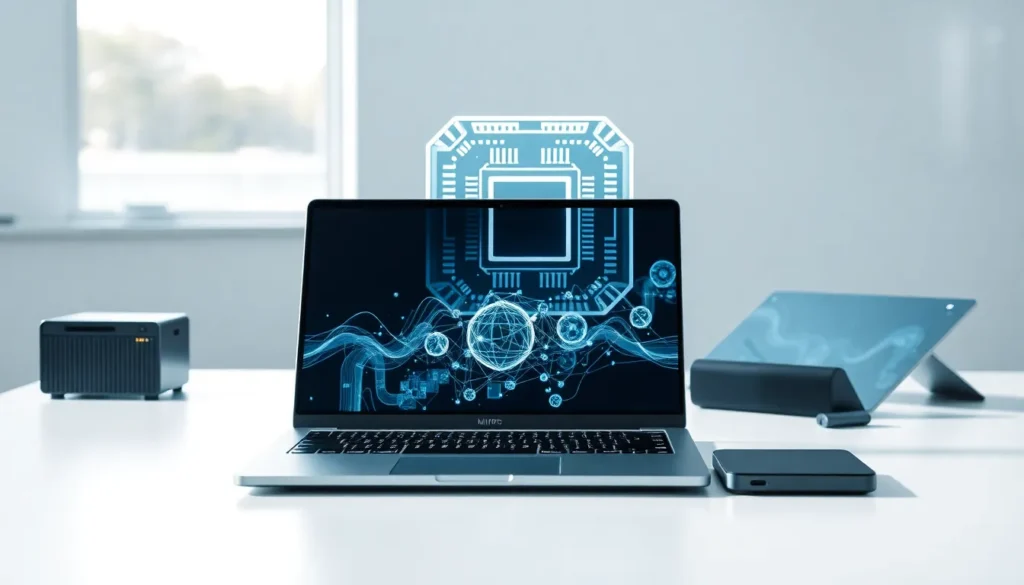
AI-optimized processors represent the biggest shift in hardware trends 2026. Major chipmakers like NVIDIA, AMD, Intel, and Apple are designing CPUs and GPUs specifically for machine learning tasks. These chips include dedicated neural processing units (NPUs) that handle AI computations more efficiently than general-purpose cores.
The numbers tell the story. NPU performance has doubled every 18 months since 2022. By 2026, most consumer laptops will include NPUs capable of running large language models locally. This means users won’t need cloud connections for many AI features.
Qualcomm’s Snapdragon X Elite series already shows this direction. The company’s chips now deliver 45 TOPS (trillion operations per second) for AI tasks. Competitors are racing to match or exceed this benchmark. Intel’s upcoming Lunar Lake processors promise similar capabilities for Windows devices.
What does this mean practically? Faster image editing. Real-time language translation. Voice assistants that actually understand context. These hardware trends 2026 will make AI feel less like a gimmick and more like a core computing feature.
Server-side hardware is evolving too. Data centers are adopting purpose-built AI accelerators at scale. NVIDIA’s H200 and AMD’s MI300X chips dominate this space. These processors consume significant power but deliver computational throughput that seemed impossible five years ago.
The AI processor race also affects software development. Developers must now optimize applications for heterogeneous computing, code that runs across CPUs, GPUs, and NPUs simultaneously. This shift requires new programming frameworks and creates opportunities for developers who master these tools early.
Next-Generation Memory and Storage Solutions
Memory and storage innovations form another pillar of hardware trends 2026. Traditional DDR5 RAM is reaching mainstream adoption, but manufacturers are already developing DDR6 standards. These next-generation modules will offer speeds exceeding 12,800 MT/s, roughly double current DDR5 performance.
Storage technology is advancing just as quickly. PCIe 5.0 SSDs now deliver read speeds above 12,000 MB/s. By late 2026, PCIe 6.0 drives should enter the market with even faster transfer rates. These speeds matter for content creators, gamers, and professionals who work with large files.
But speed isn’t everything. Capacity is expanding too. Samsung and Western Digital now ship 8TB consumer SSDs. Enterprise drives reach 60TB and beyond. This growth enables new use cases, 4K video editors can store entire project libraries locally, and gamers can keep dozens of modern titles installed without compromise.
A less visible but equally important trend involves memory architecture changes. Unified memory designs, pioneered by Apple’s M-series chips, are spreading across the industry. This approach lets the CPU and GPU share a single memory pool. The result? Lower latency, reduced power consumption, and simpler system designs.
CXL (Compute Express Link) technology deserves mention here. This standard allows servers to pool memory resources across multiple systems. Data centers can now scale memory independently from compute power. For enterprises running memory-intensive applications, CXL represents a significant operational improvement.
These hardware trends 2026 in memory and storage will benefit everyday users. Applications will load faster. Boot times will shrink further. And the frustrating “loading” screens that still plague some software will become rarer.
Advancements in Energy-Efficient Computing
Energy efficiency has become a defining priority among hardware trends 2026. Climate concerns, rising electricity costs, and battery life expectations are pushing manufacturers toward greener designs.
ARM-based processors lead this efficiency revolution. Apple’s M-series chips demonstrated that ARM architecture could deliver workstation-level performance while sipping power. Now Windows laptops with Qualcomm Snapdragon chips offer similar benefits. These processors routinely achieve 15-20 hours of battery life in thin, fanless designs.
Intel and AMD aren’t standing still. Both companies have restructured their chip architectures around efficiency cores. Intel’s hybrid approach combines high-performance cores with efficient cores on the same die. The operating system assigns tasks to the appropriate core type, saving power during light workloads.
Data centers face even greater pressure to reduce energy consumption. AI training runs consume enormous amounts of electricity, a single large model training session can use as much power as 100 homes use in a year. Hardware trends 2026 include new cooling technologies, more efficient power delivery systems, and chips designed specifically to minimize wasted energy.
Liquid cooling is becoming standard in high-performance systems. This technology transfers heat more effectively than air cooling, allowing components to run at optimal temperatures without excessive fan noise or power consumption. Some manufacturers now ship laptops with integrated liquid cooling systems.
The push for efficiency extends to manufacturing processes too. TSMC, Samsung, and Intel are racing to develop 2nm and sub-2nm fabrication nodes. Smaller transistors generally consume less power while delivering better performance. These process improvements underpin many hardware trends 2026 predictions.
Consumers benefit directly from these advances. Laptops last longer between charges. Desktops run quieter. And electricity bills stay manageable even as computing demands grow.
Emerging Form Factors and Device Innovations
New device form factors round out the major hardware trends 2026. Manufacturers are experimenting with designs that would have seemed impractical just a few years ago.
Foldable phones have matured significantly. Samsung, Google, and Chinese manufacturers like Huawei and Honor now offer devices with durable, crease-resistant displays. The technology is spreading to laptops too. Lenovo and ASUS have introduced foldable PCs that function as tablets, laptops, or dual-screen workstations.
AR and VR hardware continues its evolution. Apple’s Vision Pro established a new benchmark for mixed reality headsets. Competitors are responding with lighter, more affordable alternatives. Meta’s Quest line remains popular for gaming, while enterprise-focused devices from companies like Magic Leap target industrial applications.
Miniaturization represents another significant trend. Tiny PCs like Intel NUCs and Apple Mac Minis prove that powerful computing doesn’t require large cases. These compact devices work well as home servers, media centers, or office workstations. Hardware trends 2026 suggest even smaller form factors with desktop-class performance.
Modular design is gaining traction in some segments. Framework laptops let users upgrade individual components, RAM, storage, ports, even the mainboard. This approach extends device lifespan and reduces electronic waste. Other manufacturers are watching this model closely.
Wearables continue their march toward mainstream adoption. Smartwatches now include sensors that rival medical equipment. Smart rings offer similar health tracking in an even smaller package. The hardware trends 2026 point toward more ambient computing, devices that fade into the background while remaining always available.