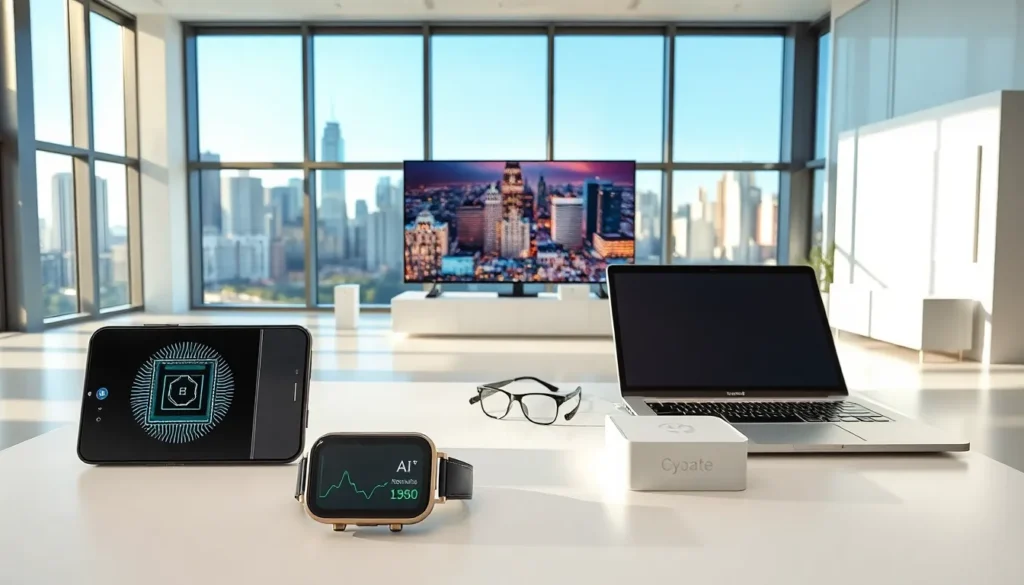

Consumer electronics trends 2026 will reshape how people interact with technology at home, work, and on the go. The industry is moving fast. AI chips are getting smarter. Wearables are becoming more health-focused. And sustainability is no longer optional, it’s expected.
This year promises significant shifts across multiple categories. From devices that anticipate user needs to gadgets built with the planet in mind, consumer electronics trends 2026 reflect a maturing market. Buyers want more than flashy specs. They want products that fit their lives, protect their data, and last longer than a single upgrade cycle.
Here’s what’s coming, and why it matters.
Table of Contents
ToggleKey Takeaways
- Consumer electronics trends 2026 highlight AI-powered devices as the new standard, with on-device chips improving privacy, battery life, and performance across smartphones, laptops, and TVs.
- Wearables are evolving from fitness trackers into serious health monitoring tools, offering blood pressure tracking, glucose monitoring, and advanced sleep analysis.
- Sustainability is driving product design, with major brands committing to recycled materials, modular repairs, and carbon-neutral manufacturing.
- The Matter standard is unifying smart home ecosystems, allowing devices from Amazon, Apple, Google, and Samsung to work seamlessly together.
- Wi-Fi 7 and smarter voice assistants are making connected homes faster, more responsive, and easier to manage.
- Consumers in 2026 prioritize durability, data privacy, and environmental responsibility over flashy specs when choosing electronics.
AI-Powered Devices Take Center Stage
Artificial intelligence is no longer a premium feature. In 2026, AI capabilities will be standard across smartphones, laptops, televisions, and even kitchen appliances. Consumer electronics trends 2026 show manufacturers embedding dedicated AI chips directly into devices. This shift reduces reliance on cloud processing and speeds up response times.
Smartphones will lead the charge. Apple, Samsung, and Google have all announced next-generation processors with on-device AI. These chips handle tasks like real-time translation, photo enhancement, and voice recognition without sending data to external servers. Privacy improves. Battery life extends. Performance feels instant.
Laptops are following a similar path. Intel, AMD, and Qualcomm are shipping processors with neural processing units (NPUs) built in. These NPUs handle AI workloads efficiently. Users can expect faster video editing, smarter autocomplete, and better noise cancellation during calls.
Televisions are getting smarter too. AI upscaling technology converts lower-resolution content into near-4K quality. Voice assistants understand context better. Some models even adjust picture settings based on ambient lighting and viewing distance.
The consumer electronics trends 2026 make one thing clear: AI isn’t just a buzzword anymore. It’s the foundation of how devices will operate.
Advances in Wearable Technology
Wearables are growing up. The fitness tracker era is giving way to serious health monitoring devices. Consumer electronics trends 2026 show wearables becoming genuine medical tools, not just step counters.
Smartwatch makers are adding new sensors. Blood pressure monitoring is becoming more accurate. Continuous glucose tracking no longer requires separate devices for some models. Sleep analysis now includes oxygen level tracking and heart rate variability measurements.
Apple, Garmin, and Samsung are pushing boundaries. The Apple Watch Series 12 is expected to feature improved blood pressure readings and a redesigned sensor array. Garmin continues to dominate among athletes with longer battery life and detailed training metrics. Samsung’s Galaxy Watch line is focusing on sleep health and stress detection.
Smart rings are gaining popularity. Brands like Oura and Ultrahuman offer discrete alternatives to wrist-worn devices. These rings track sleep, activity, and recovery without the bulk of a smartwatch.
AR glasses are also maturing. Meta and other companies are developing lightweight eyewear that displays notifications, provides directions, and even translates foreign text in real time. Consumer electronics trends 2026 suggest these devices will move from experimental to practical.
Wearable technology is becoming essential. It’s not about counting steps. It’s about understanding health.
The Rise of Sustainable Electronics
Sustainability matters more than ever. Consumers are asking tough questions about where products come from and where they end up. Consumer electronics trends 2026 reflect this shift toward greener manufacturing and longer product lifecycles.
Major brands are responding. Apple has committed to carbon-neutral products across its entire lineup. Samsung is expanding its use of recycled materials in phones and televisions. Dell and HP are designing laptops with modular components that users can repair or upgrade themselves.
Right-to-repair legislation is gaining momentum globally. The European Union has already implemented rules requiring manufacturers to provide spare parts and repair manuals. The United States is moving in the same direction. These regulations push companies to build devices that last.
Packaging is changing too. Plastic is being replaced with recycled paper and plant-based materials. Some companies ship products without chargers, assuming buyers already own compatible adapters.
Consumer electronics trends 2026 also highlight energy efficiency. New processors consume less power. Televisions use LED and OLED technology that draws fewer watts. Chargers are becoming more efficient, wasting less energy as heat.
Buyers are voting with their wallets. Products built to last and designed with the environment in mind are gaining market share.
Smart Home Integration and Connectivity
Smart homes are becoming simpler. The days of juggling multiple apps to control lights, locks, and thermostats are fading. Consumer electronics trends 2026 emphasize seamless integration through unified standards.
Matter is the game-changer. This open connectivity standard allows devices from different manufacturers to work together. Amazon, Apple, Google, and Samsung all support Matter. A single app can now control products from dozens of brands.
Wi-Fi 7 is rolling out. This new standard offers faster speeds, lower latency, and better performance when many devices share a network. Homes with dozens of connected gadgets will see noticeable improvements.
Voice assistants are improving. Alexa, Google Assistant, and Siri understand complex commands better. They can chain multiple actions together. Saying “good night” might lock doors, turn off lights, arm the security system, and set the thermostat, all at once.
Security cameras and video doorbells continue to evolve. On-device AI processes footage locally, reducing cloud storage costs and improving privacy. Facial recognition distinguishes between family members and strangers.
Consumer electronics trends 2026 point toward a unified smart home experience. Devices talk to each other. Setup takes minutes, not hours. And everything works together.